 Radiation Preparation, NYC
Rectal Spacers and Gold Fiducials for Prostate Radiation Therapy
Rectal spacers and gold fiducial markers are office-based procedures performed before prostate radiation therapy to protect the rectum from radiation injury and to allow precise targeting of the prostate during treatment.
Dr. Wei Phin Tan offers prostate spacer placement before radiation therapy, including Barrigel and SpaceOAR rectal spacers, and gold fiducial marker placement, under local anesthesia at NYU Langone Health, Main Campus in Manhattan. Procedures are coordinated with radiation oncology partners using CyberKnife, MR-Linac, and standard image-guided radiation systems. Dr. Tan places both spacers and fiducials at the same visit when appropriate.
Barrigel and SpaceOAR Hydrogel Spacers
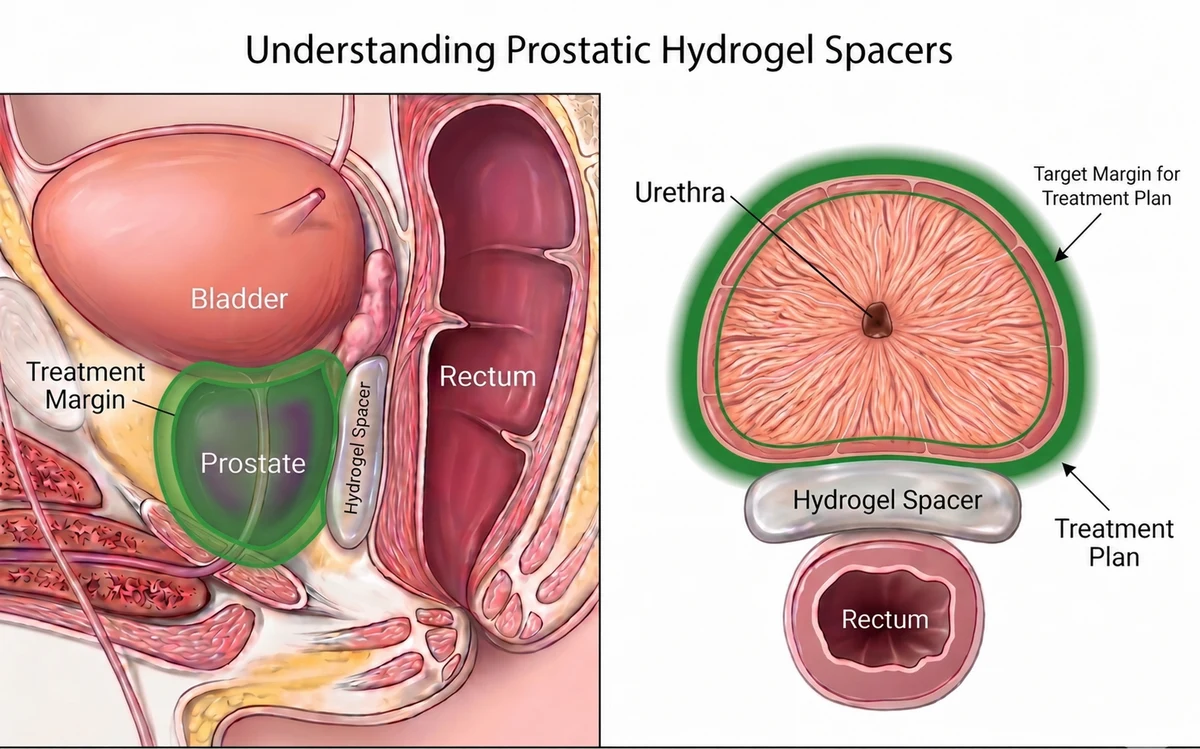
Rectal spacers are absorbable hydrogels injected between the prostate and the rectum to create a physical barrier. The added space lowers rectal radiation dose, reducing the risk of bowel toxicity, urgency, and bleeding during and after prostate radiation treatment.
Barrigel
Hyaluronic acid hydrogel
- Sculptable in real time, allowing the surgeon to control the elevation of the rectum precisely
- No 10-second injection window required, more flexibility during placement
- Greater placement control for complex anatomy
- Hyaluronic acid based, naturally absorbed
SpaceOAR / SpaceOAR Vue
Polyethylene glycol (PEG) hydrogel
- SpaceOAR is a polyethylene glycol hydrogel; SpaceOAR Vue is the radiopaque version, containing covalently bound iodine that improves visibility on CT planning scans
- Longest established clinical track record of the rectal spacer products
- FDA-cleared and widely used across radiation oncology programs
- Polyethylene glycol based, naturally absorbed
Dr. Tan offers both products. Selection depends on the radiation team's planning preferences and patient anatomy. SpaceOAR typically maintains spacing for approximately 3 months and is absorbed over about 6 months. Barrigel is also absorbable, with gradual resorption over time. Neither requires a removal procedure.
Reference Markers for Precision Radiation
Gold fiducial markers are small gold seeds (approximately 1 mm in diameter and 3 to 5 mm long) placed inside the prostate. They act as visible reference points that help radiation systems localize the prostate accurately during treatment. On platforms such as CyberKnife/Synchrony, they can support real-time prostate tracking. Without accurate image guidance, prostate position can shift by several millimeters because of rectal filling, bladder filling, and normal internal organ motion.
Compatible Radiation Platforms
Dr. Tan places fiducials for all major image-guided and stereotactic radiation systems used in prostate cancer treatment:
- CyberKnife (Accuray), robotic stereotactic body radiation therapy. CyberKnife prostate SBRT commonly relies on fiducial-based tracking; the exact fiducial requirements should be confirmed with the treating radiation oncology team.
- MR-Linac, magnetic resonance-guided radiotherapy systems including Elekta Unity and ViewRay MRIdian. These systems use MRI guidance for treatment; fiducials may or may not be requested depending on the institution's workflow.
- Standard linear accelerators with IGRT (image-guided radiation therapy), used by most academic radiation oncology programs.
- Proton therapy systems, when fiducial-based image guidance is requested.
Procedure Details
- Three to four fiducial seeds placed transperineally under local anesthesia in the office
- Procedure typically takes about 15 minutes
- Patients walk out the same day and resume normal activity the next day
- Fiducials remain permanently in place; they do not need to be removed
Why Patients Choose Dr. Tan for Spacer and Fiducial Placement
Office-Based, Same-Day, Local Anesthesia
Dr. Tan specializes in performing rectal spacer and fiducial placement under local anesthesia in the office. No general anesthesia, no operating room delays, no overnight stay. Most patients walk out within an hour and resume normal activity the next day.
Both Procedures, One Visit
Spacers and fiducials can be placed in a single combined procedure of approximately 15 to 30 minutes. This is more convenient for the patient and is the standard approach in Dr. Tan's practice.
High-Volume Transperineal Expertise
Office-based transperineal procedures are Dr. Tan's specialty. He performs 500+ transperineal biopsies per year and 2,000+ lifetime, with published low pain scores using an office-based local anesthesia technique. Spacer and fiducial placement use the same approach and skill set.
Coordination with Outside Radiation Oncologists
If your radiation oncologist is at a different hospital or institution, Dr. Tan reaches out to the radiation team in advance to confirm their preferences for spacer type, fiducial geometry, and any imaging requirements specific to their treatment platform. The transition between the placement procedure and your radiation course is seamless.
Less Vested Interest, Square Peg in Square Hole
Because Dr. Tan also performs focal therapy, robotic surgery, and active surveillance, his recommendation that radiation is the right choice for you is not shaped by what he happens to offer. If radiation is genuinely the best fit, spacer and fiducial placement is the natural next step, and you have one urologist for the whole journey.
Research-Driven Practice
Dr. Tan is the Principal Investigator on the ICE-BARR clinical trial evaluating Barrigel rectal spacing during cryoablation, in addition to its established role in radiation prep. He stays current on emerging spacer technology and outcomes data.
From Consultation to Radiation
Before
- Brief consult with Dr. Tan
- Review of MRI and prostate imaging
- Coordination with your radiation oncology team
- No bowel prep typically needed
The Procedure
- Local anesthesia in the office
- Transperineal approach
- 15 to 30 minutes total
- Spacer and fiducials in one visit when both are needed
Recovery
- Walk out the same day
- Normal activity the next day
- Mild perineal soreness possible for 24 to 48 hours
- No follow-up procedure needed
Handoff to Radiation
- Imaging shared with your radiation team
- CT or MRI planning at the radiation center
- Radiation course begins typically within 1 to 2 weeks
- Spacer absorbs naturally in 3 to 6 months
Common Questions About Spacers and Fiducials
How long do rectal spacers last?
Rectal spacers are designed to maintain protective separation during the course of prostate radiation therapy. SpaceOAR typically maintains spacing for approximately 3 months and is absorbed by the body by about 6 months. Barrigel also remains in place through radiation therapy and gradually reabsorbs over time, often beginning after about 3 months. No second procedure is needed for removal.
Are rectal spacers covered by insurance?
Rectal spacer placement is commonly covered by insurance when it is part of a planned radiation therapy course for prostate cancer. Coverage varies by plan, and our office will verify your benefits before scheduling.
What is the difference between Barrigel and SpaceOAR?
Barrigel is a hyaluronic-acid based spacer that can be shaped during placement, allowing real-time control of rectal separation. SpaceOAR is a polyethylene glycol hydrogel spacer with the longest established clinical track record. SpaceOAR Vue is the radiopaque version, containing iodine bound to the hydrogel, which improves visibility on CT planning scans. Both products are FDA-cleared and widely used. Dr. Tan offers both, and selection depends on the radiation team's planning preferences and the patient's anatomy.
Do I need fiducials for SBRT?
Fiducials are commonly used for prostate SBRT because they help the radiation system localize the prostate accurately during treatment. They are typically required for CyberKnife prostate tracking. For standard linac-based IGRT, proton therapy, and MR-Linac treatment, fiducial use depends on the radiation oncology team's workflow. Some MR-guided systems may not require fiducials because the prostate can be visualized directly with MRI.
Will the gold fiducial seeds set off airport security?
No. Prostate fiducials are very small, usually only a few millimeters in size, and do not trigger airport metal detectors.
Can rectal spacers and gold fiducials be placed at the same visit?
Yes. Dr. Tan routinely places rectal spacers and gold fiducials during the same office visit under local anesthesia. The combined procedure typically takes approximately 15 to 30 minutes and avoids the need for two separate appointments.
What if my radiation oncologist is at a different hospital?
Dr. Tan works with radiation oncology teams across NYC and beyond. For patients referred from outside institutions, he coordinates with the treating radiation oncologist in advance to confirm spacer preference, fiducial number and geometry, and any imaging or planning requirements specific to the treatment platform.
Book a Spacer or Fiducial Consultation
Whether you are scheduled for radiation therapy and need spacer or fiducial placement, or you are a radiation oncologist looking to refer a patient, Dr. Tan offers consultations at NYU Langone Health, Main Campus in Manhattan.